Overview
CJC-1295 No DAC, often called Modified GRF (1-29), is a synthetic peptide based on the first 29 amino acids of growth hormone–releasing hormone (GHRH). This portion is the active fragment responsible for stimulating the pituitary gland to release growth hormone.
How it works:
- It binds to GHRH receptors in the pituitary gland.
- This triggers the natural release of growth hormone in pulses, mimicking the body’s normal rhythm.
- Unlike the DAC version, the “No DAC” form has a shorter half-life (around 30 minutes), making its effects more natural and controllable.
CJC-1295 (No DAC) : Structure
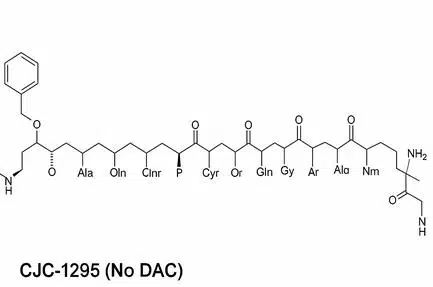
Type: GHRH (1–29) analog
Peptide Sequence: Tyr-D-Ala-Asp-Ala-Ile-Phe-Thr-Asn-Ser-Tyr-Arg-Lys-Val-Leu-Gly-Gln-Leu-Ser-Ala-Arg-Lys-Leu-Leu-Gln-Asp-Ile-Met-Ser-Arg-NH₂
Length: 29 amino acids
Molecular Formula: C₁₅₂H₂₅₂N₄₄O₄₂
Molecular Weight: ~3368.7 g/mol
What Makes CJC-1295 NO DAC Unique in Research Settings
CJC-1295 NO DAC is a modified version of the first 29 amino acids of endogenous GHRH, engineered for greater structural stability and potency compared to the unmodified form. Although its half-life is relatively short, typically minutes to a few hours, depending on the assay and model, this brevity is intentional. Many laboratory applications require acute bursts of GH signaling to observe downstream mechanisms that would be obscured by prolonged elevation.
Because DAC-based CJC-1295 circulates for days, it provides continuous GH stimulation, which may not suit research protocols that require isolated pulse responses. The NO-DAC version, by contrast, delivers clearly defined GH pulses, allowing researchers to examine the immediate effects of short-acting stimulation. This creates a high-fidelity model for studying circadian influences, cellular regeneration events, metabolic triggers, and GH-dependent pathways.
Another distinguishing feature is its synergy with GHRP-class peptides, such as Ipamorelin or GHRP-2/6. These peptides act on separate receptors, and combining them can create dual-pathway stimulation without escalating interactions on unrelated endocrine axes. This dual-signal effect is of notable interest in studies measuring amplified GH release and examining the interplay between GHRH-mediated and ghrelin-mediated signaling.
Key Areas of Interest in CJC-1295 NO DAC Research
Below are commonly researched outcomes associated with CJC-1295 NO DAC in non-clinical, non-human, and non-animal laboratory environments. These points reflect research observations only and must not be interpreted as human-use benefits.
1. GH Pulsatility and Circadian Rhythm Models
Research frequently uses CJC-1295 NO DAC to evaluate how short-acting GHRH analogs influence rhythmic GH patterns. Because it produces brief, defined pulses, it aligns well with studies focused on timing-dependent GH secretion.
2. Tissue Repair and Cellular Recovery Processes
Some research models show that pulse-based GH stimulation may influence protein synthesis, cellular repair markers, and anabolic signaling pathways. These models are useful for understanding GH-driven recovery mechanisms.
3. Lipid Metabolism and Energy Utilization Studies
GH is known to participate in lipolytic pathways. Research using CJC-1295 NO DAC often explores how acute GH signals affect lipid mobilization, metabolic substrates, and energy turnover in controlled environments.
4. Sleep-Cycle and Circadian Research
Because endogenous GH typically peaks during specific rest phases, CJC-1295 NO DAC is used in studies examining how acute GH pulses correlate with sleep-associated biochemical patterns.
5. Collagen, Connective Tissue, and Cellular Health Markers
Several experiments examine GH’s role in processes related to collagen signaling, cellular turnover, and skin-related markers under strictly controlled research conditions.
6. Synergistic Use With GHRP-Class Peptides
When combined with peptides such as Ipamorelin, research shows amplified GH pulses—allowing researchers to examine multi-pathway GH stimulation without excessive off-target hormonal interference.
Mechanism of Action in Research
CJC-1295 NO DAC binds to GHRH receptors located on pituitary cells in research models, initiating a short-lived GH release event. Because of its short half-life, it does not override baseline hormonal rhythms but instead enhances or augments the naturally occurring GH pathway during specific timing windows. This makes it particularly useful for studies examining:
- acute endocrine responses
- GH receptor sensitivity
- downstream IGF-1 modulation
- energy metabolism changes
- tissue-specific effects of pulse-based GH secretion
The peptide’s precision makes it valuable for experimental setups requiring fine control over the timing of growth hormone signaling events.
Why Licensed Peptides for CJC-1295 NO DAC?
Licensed Peptides supplies research-grade CJC-1295 NO DAC produced under stringent quality standards designed for laboratory, academic, and scientific research use only. All peptide solutions are handled in U.S.-based facilities, packaged securely, and shipped promptly to maintain integrity during transit.
The online ordering process is designed for professional environments requiring efficient procurement. The platform supports major credit and debit cards, ensuring streamlined acquisition for universities, biotechnology labs, and research institutions performing controlled peptide-related studies.
All materials are clearly labeled NOT FOR HUMAN OR ANIMAL USE and are intended solely for in-vitro, ex-vivo, or controlled laboratory applications.
Frequently Asked Questions (FAQ)
(All responses are research-focused and do not imply human or animal application.)
1. What is CJC-1295 NO DAC?
CJC-1295 NO DAC is a short-acting GHRH analog used in laboratory environments to investigate growth hormone pulsation patterns. Without the Drug Affinity Complex, it behaves more like natural GHRH, creating clean, acute GH responses in research models.
2. How does CJC-1295 NO DAC work?
It binds to pituitary GHRH receptors in research assays, encouraging short-burst GH secretion. Researchers often describe this as a “tap” rather than continuous stimulation, allowing precise measurement of acute GH pathways.
3. How does NO-DAC differ from the DAC version?
- NO-DAC: Short-acting, precise, ideal for timing-specific studies.
- DAC: Long-acting, remains active for days, creating sustained GH exposure.
Researchers select NO-DAC when studying immediate or circadian-based responses.
4. What research areas involve CJC-1295 NO DAC?
Studies commonly explore GH release mechanics, IGF-1 pathway modulation, tissue regeneration markers, metabolic functions, cellular repair signals, and nighttime GH pulse modeling.
5. Why is it often paired with Ipamorelin in studies?
CJC-1295 NO DAC activates GHRH receptors, while Ipamorelin acts on ghrelin receptors. Together, they generate a combined GH pulse through separate pathways, offering researchers an amplified yet selective GH signal.
6. What is the half-life of CJC-1295 NO DAC?
Its half-life typically spans minutes to several hours depending on the research system. This short duration is essential for experiments requiring rapid, time-dependent GH stimulation.
7. Does CJC-1295 NO DAC influence IGF-1 in research?
Some published studies show that it may increase IGF-1 levels through pulse-based GH release. These increases occur within the context of natural GH pulsatility, making it useful for IGF-1 regulatory studies.
8. Is CJC-1295 NO DAC considered selective?
Many studies note that CJC-1295 NO DAC does not significantly elevate cortisol or prolactin, allowing researchers to generate cleaner datasets without excessive hormonal interference.
9. Why this peptide is widely used in performance-related research fields?
Athletic and performance-based research often studies GH’s influence on recovery markers, adaptation indicators, and stress-response mechanisms. The peptide’s short-pulse behavior makes it valuable in these models.
10. How should CJC-1295 NO DAC be stored for research?
Research-grade CJC-1295 NO DAC is typically kept refrigerated, both before and after reconstitution, to maintain stability throughout experimental use.
11. Can CJC-1295 NO DAC be used daily in research protocols?
Because of its brief action window, some research models employ multiple weekly administrations or combine it with other short-acting peptides to investigate repeated GH pulses.
12. Why is CJC-1295 NO DAC sometimes described as a “clean” GHRH analog?
Researchers use this term to describe its predictable, short-lived GH pulse without extended hormonal elevation or unwanted overlap into unrelated endocrine pathways.
13. Why is endotoxin testing important for CJC-1295 NO DAC research?
Endotoxin contamination can interfere with cellular signaling, inflammatory markers, and immune-related pathways in experimental models. Using research peptides endotoxin tested helps ensure that observed effects are attributable to the peptide itself rather than external contaminants.
14. What does it mean that CJC-1295 NO DAC is an LPS-free peptide?
An LPS-free peptide indicates that the compound has been manufactured and verified to be free of lipopolysaccharides, which are known to disrupt biological assays and skew experimental data, particularly in immune-sensitive research models.
15. How does high purity impact experimental reliability?
A high purity peptide reduces variability caused by synthesis byproducts or impurities. This allows researchers to achieve more consistent, reproducible results when studying GH-related signaling and molecular interactions.
16. Is this peptide suitable for use in sensitive cell-based assays?
Yes, when supplied as an endotoxin free peptide and verified as research peptides endotoxin tested, CJC-1295 NO DAC is well-suited for controlled laboratory studies, including cell culture and mechanistic research applications.
CJC-1295 No DAC: Research
CJC-1295 No DAC & Intestine
Researchers developed several stable analogues of growth hormone-releasing factor (GRF) to explore their therapeutic potential. One potent analogue, GRF-6, caused severe diarrhea in monkeys during prolonged infusion but had no adverse effects in rats. Since GRF shares structural similarities with VIP/PACAP peptides, which are known to cause diarrhea when overproduced, the study examined whether GRF analogues interact with VIP/PACAP receptors.
Key Results:
- Native hGRF(1-29) had weak binding to rat and human VPAC1/VPAC2 receptors, while VIP bound strongly.
- GRF-6 showed weak binding to rat receptors but higher affinity for the human VPAC1 receptor (not VPAC2).
- In guinea pig pancreatic cells, all GRF analogues acted as full agonists, triggering enzyme release.
Conclusion
Unlike natural hGRF, GRF-6 selectively interacts with the human VPAC1 receptor, which likely explains the diarrhea observed in monkeys. The study highlights important species differences in receptor responses, stressing the need to test peptide agonists on human or closely related cells before therapeutic use.
Thyroid Hormone Therapy Restores Growth Hormone Response to GRF in Hypothyroidism
People with hypothyroidism often show reduced growth hormone (GH) responses. This study tested how GH reacts to growth hormone–releasing factor (GRF) in 14 patients with primary hypothyroidism, both before and after thyroid hormone (T4) replacement therapy.
When patients received daily T4 treatment, their GH response to GRF significantly improved. Peak GH levels nearly doubled, and the overall GH release (measured by the area under the curve) increased in most patients.
Thyroid hormone replacement helps restore the pituitary gland’s ability to respond to GRF, showing that proper thyroid function is important for normal GH regulation in people with hypothyroidism.
Referenced Citations
Ito T, Igarashi H, Pradhan TK, Hou W, Mantey SA, Taylor JE, Murphy WA, Coy DH, Jensen RT. GI side-effects of a possible therapeutic GRF analogue in monkeys are likely due to VIP receptor agonist activity. Peptides. 2001 Jul;22(7):1139-51. doi: 10.1016/s0196-9781(01)00436-3. PMID: 11445245.
Valcavi R, Jordan V, Dieguez C, John R, Manicardi E, Portioli I, Rodriguez-Arnao MD, Gomez-Pan A, Hall R, Scanlon MF. Growth hormone responses to GRF 1-29 in patients with primary hypothyroidism before and during replacement therapy with thyroxine. Clin Endocrinol (Oxf). 1986 Jun;24(6):693-8. doi: 10.1111/j.1365-2265.1986.tb01666.x. PMID: 3098458.


